
The making of a bespoke piece does not end with the last stone being set.
It begins with the stones.
A bespoke bracelet is rarely designed all at once. It develops through a sequence of choices — finding the stones, assembling the right layout, exploring proportion and design, and bringing together the specialist skills required to make it.
In Idar-Oberstein, those skills can extend from gemstone cutting and goldsmithing to the centuries-old art of gemstone engraving.
Follow one of our current commissions as it takes shape.
Finding the stones
A bracelet asks something unusual of gemstones.
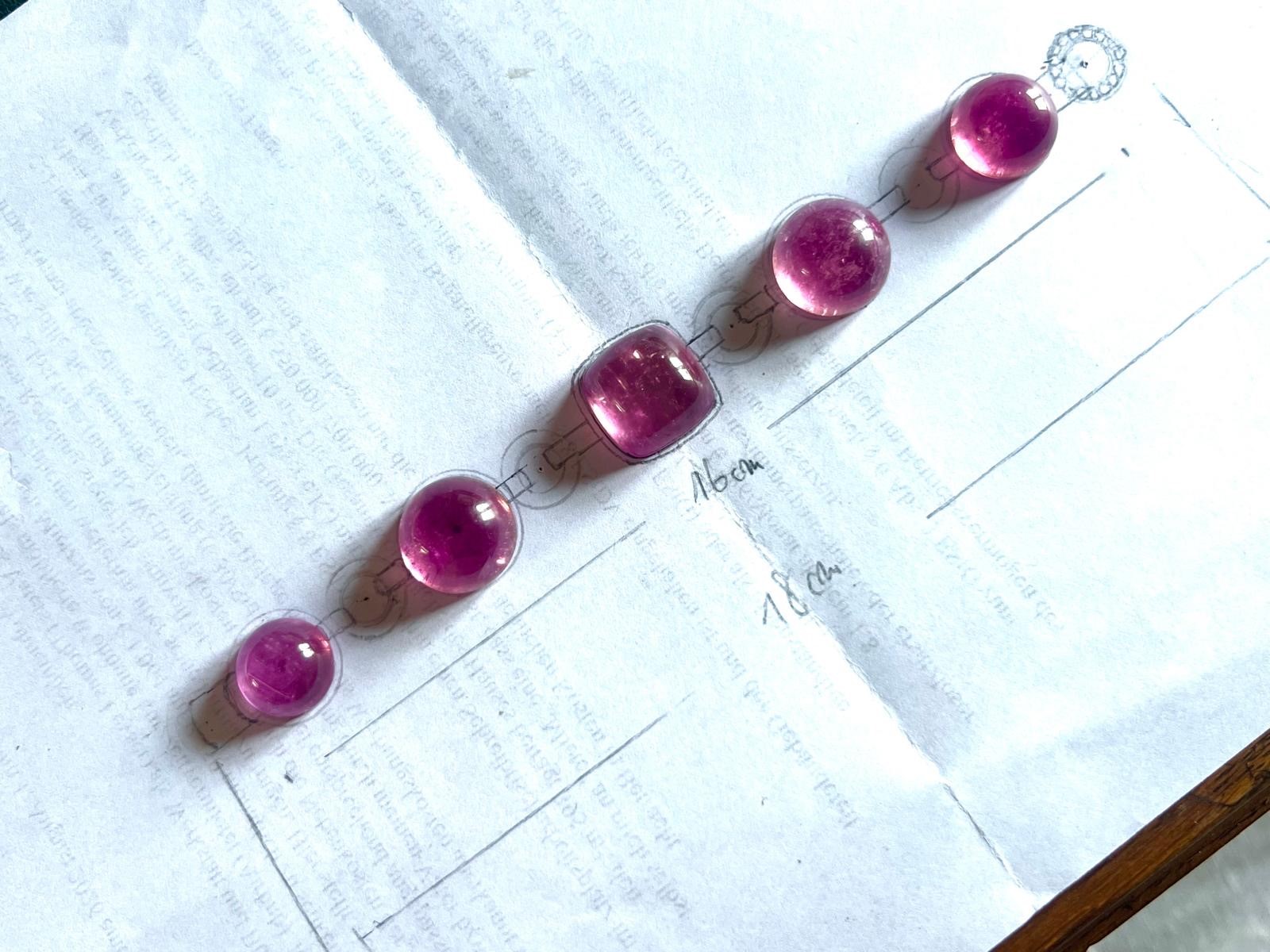
Finding one exceptional stone is one thing. Finding a group that belongs together is another. Colour, saturation, shape, size and character all have to work across the wrist — while allowing each stone to retain its individuality.
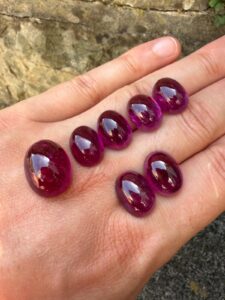
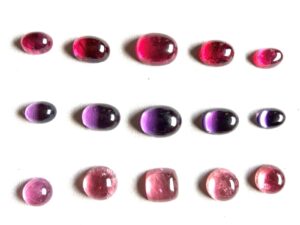
For this commission, the search began with pink tourmalines and rubellites. Different parcels and layouts were considered, compared and rearranged before a group of stones began to emerge.
This is where much of the work happens before a design is ever drawn.
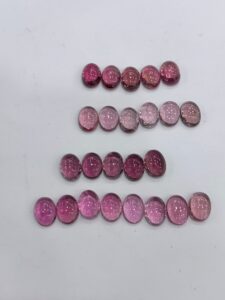
Matching does not mean identical.
The aim is not to eliminate every variation, but to find a rhythm between the stones — where differences in tone and proportion become part of the composition.
From layout to design
Gradually, a selection becomes a composition.
Once the stones begin to find their place, the design can take shape.
In this commission, the bracelet was conceived not simply as a sequence of gemstones, but as something more personal. A family of bears became the starting point for a central engraved motif — turning the bracelet into a piece that carries a story as well as colour.
Early sketches explored the composition, the relationship between the figures and, importantly, how an image conceived on paper might eventually work within a gemstone.
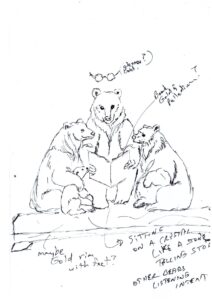
Ideas are allowed to remain ideas for a while. Proportion, posture and detail are explored before anything is committed to stone.
Designing around the stone
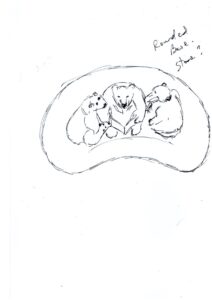
A gemstone sets its own parameters. Its dimensions, colour, transparency and curvature determine what can be achieved — and sometimes change the design itself.
The bracelet therefore develops in both directions: the stones inform the drawing, and the drawing changes what we look for in the stones.
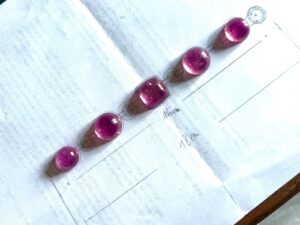
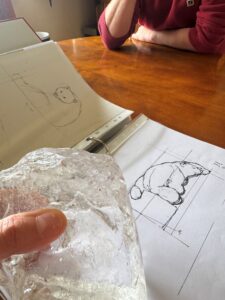
From there, the conversation moves from designer to craftsman. Drawings, gemstones and ideas come together around a table — each specialist considering what the material will allow.
A drawing becomes a carving
Some designs can be drawn. Others have to be discovered in the stone.
Gemstone engraving adds another dimension to the process. The engraver has to translate a two-dimensional drawing into depth, working with the colour, transparency and physical limits of the material rather than simply reproducing an image.
It is a highly specialised craft — and one that remains very much alive in Idar-Oberstein.
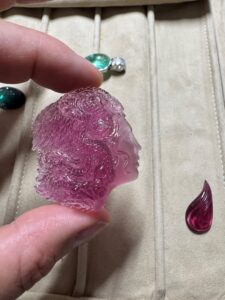
From drawing to stone.
Every line has to be reconsidered once the engraver begins to work in three dimensions.
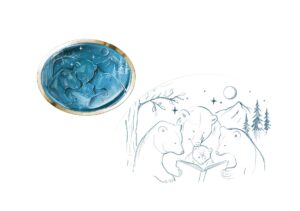
For the bracelet, the family of bears gradually evolved from the first loose sketches into a composition conceived specifically for engraving.
Details were simplified, positions adjusted and the scene reconsidered within the boundaries of an oval gemstone. What works beautifully on a sheet of paper does not necessarily work at the scale of a stone worn on the wrist.
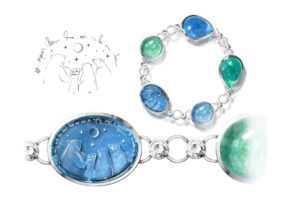
The bracelet begins to reveal itself.
Gemstone selection, engraving, setting and construction are no longer separate decisions. Each begins to influence the others — the size of an engraved stone affects the links around it; colour determines neighbouring stones; and the structure of the bracelet has to accommodate both the design and the wrist.
Made by many hands
The piece takes shape through collaboration.
It brings together gemstone specialists, designers, engravers, setters and goldsmiths — each contributing a particular skill at a particular moment.
Our role is to bring those disciplines together: sourcing the stones, developing the design and orchestrating the making of the piece with specialist artisans in and around Idar-Oberstein.
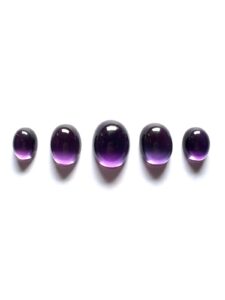
The final detail begins before the bracelet is finished
The making of a bespoke piece does not end with the last stone being set.
While the bracelets are still taking shape in the atelier, their cases are already being made in Italy by Floriani. For each, we selected combinations of nappa d’agnello and scamosciato d’agnello — lambskin nappa and lamb suede — choosing colours and textures to complement the pieces they will eventually hold.
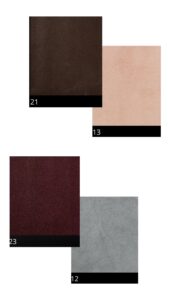
The bracelets are still in the making. So are their cases.
We will continue to follow their progress as the pieces take shape.
A bracelet of your own
Every bespoke commission begins differently. Sometimes with a gemstone. Sometimes with an idea. Sometimes simply with a conversation.
If you have something particular in mind, we would be pleased to explore it with you.
